Enterprise AI is entering a more demanding phase. The ability to develop intelligent applications is no longer the primary challenge. The real test lies in deploying AI systems that are reliable, secure, economically sustainable and accountable for their actions.
This becomes particularly important as organisations move towards agentic AI, where systems can make decisions, interact with enterprise applications and execute tasks with increasing autonomy.
Traditional governance approaches, built around policies, periodic reviews and human-operated systems, are not sufficient on their own. Organisations need to translate governance principles into enforceable technical controls throughout the AI lifecycle.
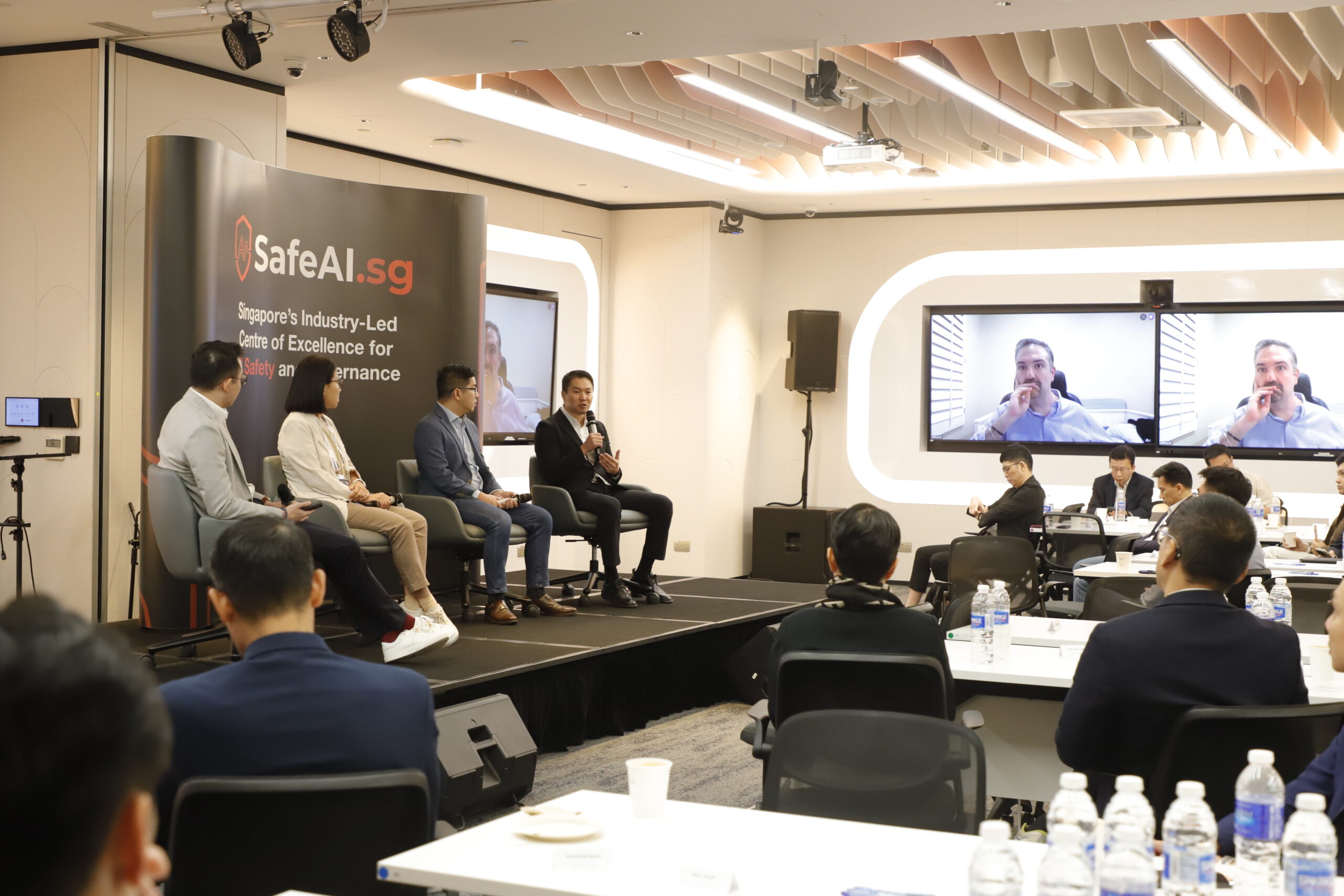
Insights from the inaugural SafeAI.sg Summit highlight several foundations for building this capability, from use-case readiness and risk assessment to runtime security, organisational accountability and operational resilience.
AI Readiness Begins with the Business Problem
The growing accessibility of AI development tools has accelerated experimentation across enterprise functions. However, the ease of building prototypes can obscure fundamental questions about business value, data readiness and implementation feasibility.
Successful AI adoption starts with identifying the right problems rather than selecting the most sophisticated technology.
Organisations need to understand which processes would benefit from automation, whether the underlying data is sufficiently reliable and how improvements will be measured. Customer experience, workforce productivity, revenue opportunities and total cost of ownership all contribute to a meaningful assessment.
A strong data strategy is equally essential. Data quality, accessibility, privacy and governance directly influence whether AI solutions can progress from controlled demonstrations to dependable enterprise applications.
To support this process, SafeAI.sg introduced three complementary resources:
- AI PULSE helps identify operational challenges, assess AI readiness and determine where human oversight should remain.
- AI Risk Studio evaluates AI use-case risks, producing explainable assessments aligned with relevant governance frameworks and prioritised recommendations.
- AI Harness Reference Architecture provides a common blueprint for implementing shared governance, security and operational controls across AI systems.
Together, these resources reflect a practical progression: identify appropriate opportunities, understand their risks and establish the architecture required for responsible deployment.
Governance Must Become an Engineering Capability
One of the most significant gaps in enterprise AI lies between governance expectations and technical implementation.
Policies may require accountability, data protection and human oversight, but these principles have limited value unless organisations can demonstrate how they are enforced.
The OWASP AI Security Verification Standard (AISVS) addresses this challenge by translating security objectives into specific, testable and implementable requirements.
Its approach complements broader governance frameworks by providing developers, architects, security teams and procurement professionals with a means of verifying technical safeguards.
Consider an AI agent responsible for processing supplier invoices. A malicious document could contain instructions designed to manipulate the agent into changing payment details.
Preventing such an incident cannot depend entirely on the model recognising malicious content.
The surrounding architecture must enforce permissions, require human approval for sensitive actions, validate authorisation, record activity and stop execution when predefined limits are reached.
This illustrates a fundamental shift in AI security: organisations must design systems that remain controlled even when the underlying model behaves unexpectedly.
Security assurance must therefore extend across design, development, testing, procurement and continuous production monitoring.
Agentic AI Requires Clear Boundaries of Authority
Agentic AI introduces a distinction that enterprise leaders cannot afford to overlook: access to information does not automatically imply authority to act.
An agent may need to retrieve customer records to answer an enquiry without having permission to modify those records, disclose sensitive information or initiate financial transactions.
These boundaries must be explicit and technically enforced.
A useful approach is to treat an AI agent similarly to a newly appointed employee. It should receive clearly defined responsibilities, limited permissions and progressively greater authority only when justified by operational requirements.
This requires identity management, least-privilege access, action-level authorisation and appropriate human intervention points.
The AI harness becomes particularly valuable in this context, providing shared controls rather than requiring individual teams to recreate governance mechanisms for every application. Me
However, technical safeguards alone cannot establish accountability.
Business owners must remain responsible for intended outcomes, while technology and product teams are accountable for implementation and operational performance. Clear ownership is essential when systems produce unexpected results or require intervention.
Trust Depends on Evidence, Not Demonstrations
AI pilots can demonstrate technical potential without providing sufficient evidence of production readiness.
Enterprise decision-makers need confidence that systems perform consistently under realistic conditions, including unexpected inputs, operational disruptions and changing data environments.
This calls for representative testing, transparent performance limitations, measurable business outcomes and continuous evaluation.
Trust also develops through experience. Users expect AI applications to be responsive, accurate and dependable before they will confidently rely on them for consequential activities.
Human judgement remains central to this process.
Employees need the ability to question AI outputs, recognise limitations, determine when automation is appropriate and identify situations requiring escalation.
Developing these competencies is as important as improving technical proficiency. Organisations that distribute AI capabilities widely must also ensure that users understand their responsibilities.
Ultimately, trustworthy AI is not defined by the absence of errors, but by an organisation’s ability to detect, contain and respond to them.
Scaling AI Requires Operational and Financial Discipline
Moving AI into production introduces challenges that are often underestimated during experimentation.
Infrastructure consumption, token usage, model selection, orchestration complexity and continuous monitoring all influence operating costs.
The economics become more unpredictable as agentic systems perform multi-step tasks and interact with multiple tools or models.
AI FinOps must therefore become part of enterprise architecture and governance decisions, rather than an exercise undertaken after deployment.
Organisations need visibility into consumption patterns, cost allocation and the relationship between AI expenditure and measurable business outcomes.
Resilience requires equal attention. Monitoring, execution limits, auditability and intervention mechanisms allow organisations to scale AI capabilities without surrendering operational control.
The appropriate level of assurance should also reflect the consequences of failure. A low-risk productivity assistant does not require the same safeguards as an autonomous system operating within financial services or critical infrastructure.
Risk-proportionate controls enable organisations to balance innovation, security and operational efficiency.
Closing Thoughts: From AI Capability to Enterprise Confidence
The next stage of AI maturity will be defined less by the number of applications organisations deploy and more by their ability to demonstrate that those applications operate responsibly at scale.
Achieving this requires a connected approach to business readiness, data governance, technical verification, agent permissions, human accountability and financial sustainability.
These capabilities cannot function as isolated initiatives. They must form part of a coherent operating model in which governance is embedded into architecture, engineering and everyday decision-making.
The transition from experimentation to production is ultimately a transition from proving that AI can work to demonstrating that it can be trusted.
For enterprise leaders, that is the real foundation of sustainable AI adoption.