
The next frontier of enterprise AI is not simply about building more capable models. It is about creating the infrastructure that allows AI agents to operate reliably, access the right information and deliver measurable business value at scale. While advances in generative AI have accelerated experimentation, moving autonomous agents into production presents a different set of challenges. Reliability, inference costs, fragmented enterprise data and the management of agent memory are emerging as critical considerations for organisations looking to operationalise AI.
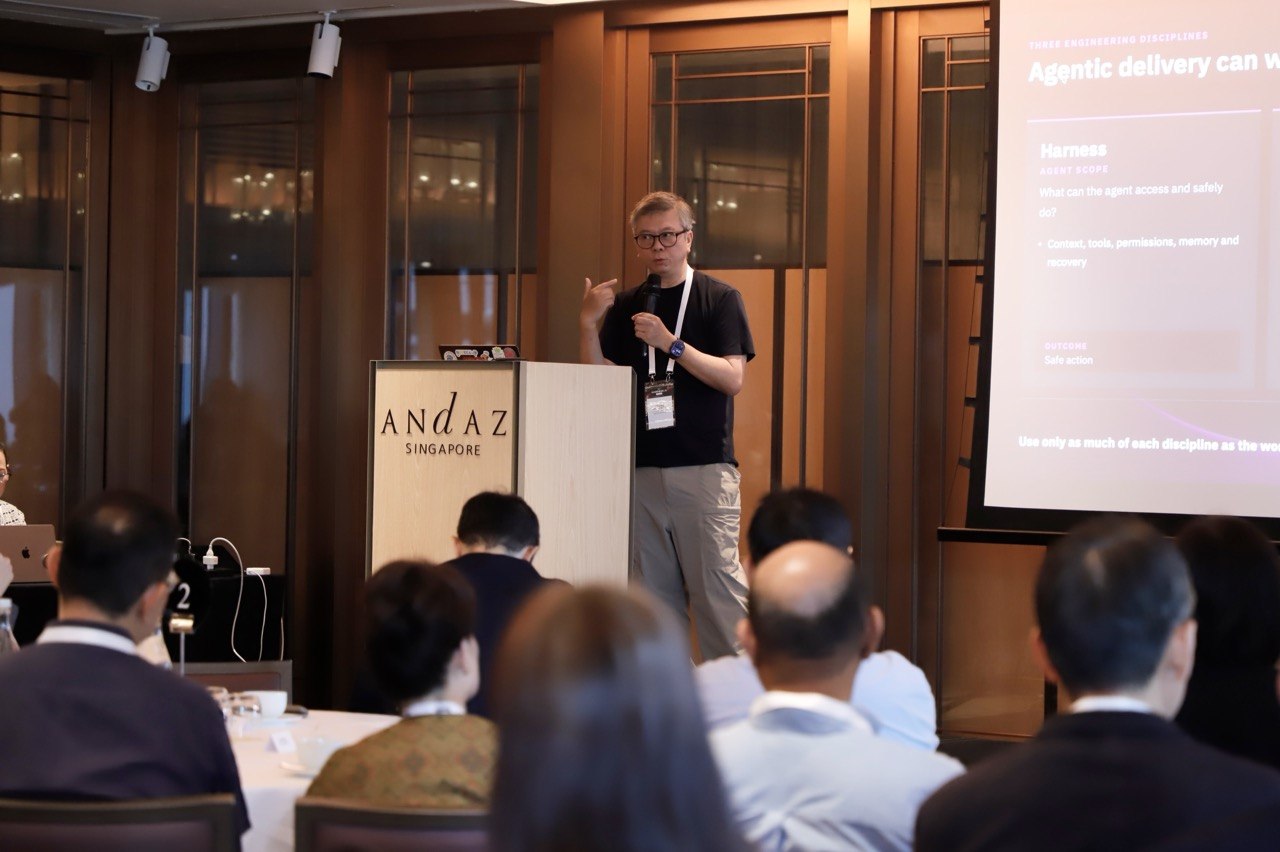
In a conversation between Rowan Trollope, CEO of Redis, and David Chin, Chief Executive of SPARK, the two explored how real-time context, intelligent memory architectures and modular infrastructure can help enterprises bridge the gap between AI experimentation and production, while protecting the proprietary knowledge that differentiates their businesses.
Beyond Experimentation: The Challenge of Scaling AI
The transition from AI pilots to production-ready applications remains one of the most significant hurdles for enterprises. Two challenges stand out: achieving deterministic reliability and managing the escalating costs of inference and token consumption. Unlike conventional software, autonomous AI agents operate with varying degrees of independence, interpreting information, making decisions and executing tasks across different systems. This introduces new demands for consistency, resilience and predictable performance.
The challenge is compounded by the speed of technological change. New models, frameworks and infrastructure capabilities are emerging faster than many organisations can evaluate or deploy them. Trollope describes this transitional phase as the “messy middle” of enterprise AI adoption, where organisations must make long-term architectural decisions in a market that has yet to settle. Committing too heavily to a particular technology stack risks obsolescence, while delaying investment may limit an organisation’s ability to develop valuable AI capabilities.
The priority is therefore to establish flexible foundations that support changing technologies without requiring extensive reengineering each time a new model or platform emerges.
Why Context and Memory Matter
The effectiveness of an AI agent depends not only on its reasoning capabilities but also on the quality, relevance and accessibility of the information available to it. Although large language models support increasingly extensive context windows, simply loading an agent with historical conversations and enterprise data is neither efficient nor sustainable. Instead, intelligent agents require structured memory systems capable of identifying, retaining and retrieving relevant information.
This includes semantic memory, which captures facts and knowledge, and procedural memory, which preserves information about how tasks have been successfully completed. An agent that can recall a previously successful workflow, for example, may avoid repeating the same reasoning and execution steps, improving both efficiency and consistency.
However, memory management involves more than retaining information. It also requires the ability to reconcile conflicting knowledge, consolidate relevant facts and discard outdated or unnecessary details. Drawing parallels with human memory, Trollope highlights the importance of compression and strategic forgetting. Without these mechanisms, an agent’s context can become cluttered with stale or contradictory information, potentially affecting the quality of its decisions. For enterprises, effective memory management is becoming a fundamental requirement for building AI systems that can operate continuously and reliably.
Building a Real-Time Context Layer
Enterprise information rarely exists within a single system. Critical business data is often distributed across databases, applications and operational environments, creating challenges for AI agents that need timely access to relevant context. A dedicated, low-latency context layer can help bridge these fragmented environments, enabling agents to retrieve information when needed without repeatedly processing large volumes of data.
Redis, traditionally known for its high-performance data capabilities, is positioned between enterprise data and applications, providing an architectural foundation for real-time AI context and memory management. This approach allows organisations to separate the storage and retrieval of agent memory from the underlying AI models, improving both performance and architectural flexibility.
Caching also plays an important role in managing the economics of enterprise AI. Multi-layer caching techniques, including prompt caching and key-value (KV) caching, can reduce redundant computation, minimise latency and lower the costs associated with repeated inference. As organisations deploy AI agents across increasingly complex workflows, these efficiencies become more consequential. The ability to reuse previously processed information and successful execution patterns can help reduce operational overhead while supporting more responsive applications.
Ultimately, the performance of enterprise AI depends not only on model intelligence but also on how efficiently information moves between enterprise systems, memory infrastructure and AI applications.
Protecting Enterprise Knowledge and Competitive Advantage
As AI models become increasingly capable and accessible, the source of competitive differentiation is shifting. The underlying intelligence provided by frontier models is becoming more widely available, while model providers are also expanding into specialised enterprise applications and software. This raises an important strategic question: how can organisations protect the proprietary knowledge and operational capabilities that distinguish their businesses?
Trollope refers to this accumulated organisational value as “business alpha”, encompassing the knowledge, workflows, decision-making processes and operational expertise developed through years of business activity. While an organisation may change its AI models or infrastructure providers, its proprietary knowledge remains a valuable and potentially irreplaceable asset.
Embedding this knowledge too deeply within a single model provider’s ecosystem could create dependencies that limit future flexibility and weaken control over intellectual property. A decoupled memory architecture offers an alternative. By maintaining enterprise context, agent memory and operational logic independently of the underlying AI models, organisations can preserve their accumulated knowledge while retaining the freedom to adopt new technologies. This separation becomes increasingly important as frontier models evolve and providers expand their offerings.
The strategic value of enterprise AI may ultimately lie less in the models themselves and more in the proprietary context and capabilities that organisations build around them.
Designing for Flexibility in an Evolving AI Landscape
For enterprise technology leaders, architectural decisions must balance immediate operational requirements with long-term adaptability. The rapid pace of AI innovation makes it difficult to predict which models, platforms or infrastructure approaches will dominate over the coming years. Rigid technology commitments may therefore introduce unnecessary risk.
A modular, multi-model architecture provides greater flexibility, allowing organisations to select different models and cloud environments according to specific workload requirements. Separating enterprise memory and application logic from the underlying models also makes it easier to accommodate future technological changes without rebuilding core business capabilities. For boards evaluating AI investments, this approach offers a more adaptable foundation for managing uncertainty.
Rather than committing to a single technology ecosystem, organisations can prioritise interoperability, portability and the ability to evolve their architectures as the market matures. Established architectural approaches from major enterprises can also provide useful reference points for organisations seeking to balance innovation with operational resilience.
The objective is not to predict which AI platform will prevail, but to ensure that enterprise investments remain valuable regardless of how the technology landscape develops.
From Individual Agents to Reusable Enterprise Intelligence
One of the longer-term opportunities in enterprise AI lies in transforming individual agent interactions into reusable organisational capabilities. When an AI agent successfully completes a complex task, the steps involved may contain valuable procedural knowledge that can be applied to similar workflows. Capturing and retaining this information allows agents to build upon previous executions rather than repeatedly solving the same problems.
Over time, this can create a shared repository of operational knowledge that supports more efficient and consistent agent behaviour. However, the effectiveness of such systems depends on maintaining the quality of stored information. Successful workflows must be evaluated for continued relevance, updated when business requirements change and discarded when they become obsolete.
This requires memory architectures that support continuous refinement rather than simply accumulating historical data. The result is a more sustainable approach to enterprise AI, where organisational knowledge becomes increasingly reusable without unnecessarily increasing computational costs.
Building the Foundations for Sustainable Enterprise AI
The ability to scale autonomous AI will depend on more than advances in model capabilities. Enterprises need infrastructure that can deliver relevant context in real time, manage memory intelligently and support predictable performance without allowing operational costs to escalate uncontrollably. Equally important is the need to maintain control over proprietary business knowledge while preserving flexibility across models, platforms and cloud environments.
These considerations point towards a broader shift in enterprise AI strategy, from focusing primarily on model selection to building the architectural foundations that enable AI to operate effectively within the business. For technology leaders, the priorities are clear: improve reliability, optimise inference economics, establish intelligent memory management and protect the organisational knowledge that creates competitive advantage.
As AI intelligence becomes more accessible, the differentiator will be how effectively enterprises manage the context, memory and proprietary knowledge that turn that intelligence into business value.